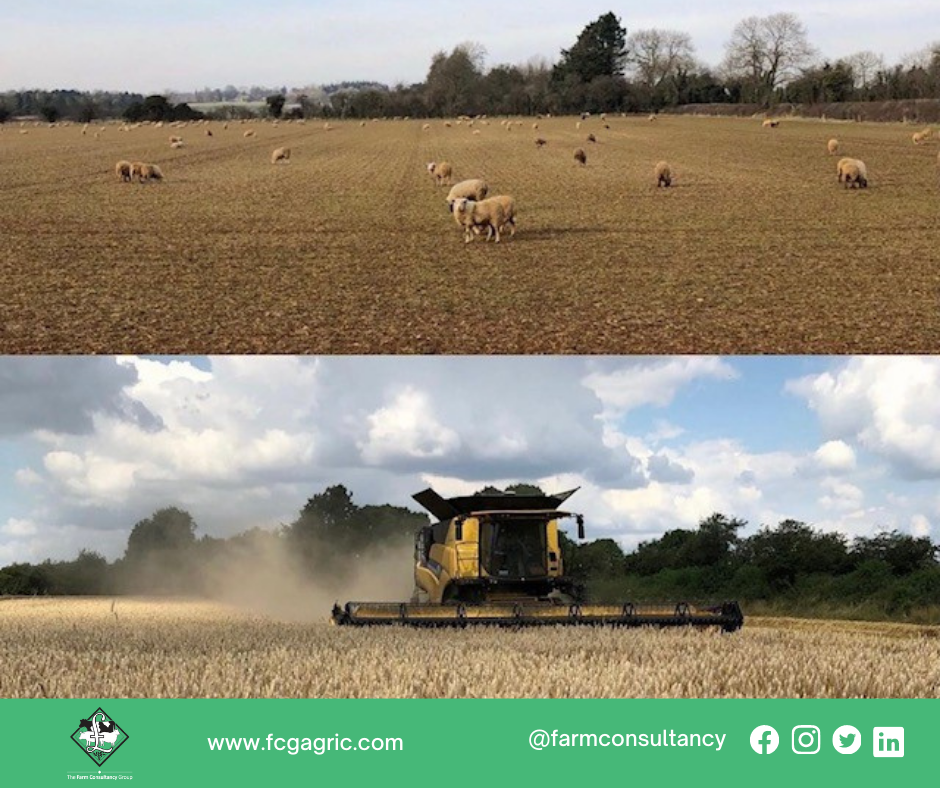
No, Those Sheep Are Not Out!!! – Steph Emmerson (Chippenham) B4
Grazing cereal crops is not new, but should we be seeing more of it?
Grazing of winter cereals can provide valuable winter forage for sheep and benefit the crop yield. Some studies show an increase of 0.5-0.75t/ha on the grazed areas.
Not only a yield increase is likely, but it also greatly benefits the soil structure giving scope to drill winter crops two to three weeks earlier.
A trial in the Cotswolds, carried out by Ed Horton on his own farm grazing lambs on Winter Triticale illustrates further benefits to fungicide use, or lack of! Two fields were selected for this trial. Both were very forward crops having grown over the winter and were full of disease, mainly yellow rust.
One field was grazed hard by lambs in February this year (a time when forage supplies were low), the other un-grazed and given ‘normal’ treatment of tebuconazole, a fungicide that targets rust in plants.

Fast forward 4 months, and both crops are at the same growth stage, however, there is an obvious difference between the two fields. The grazed field has three more ears per plant on average and has some yellow rust appearing, compared to the un-grazed field which has had two doses of fungicide and two doses of growth regulator which has had its green area destroyed by yellow rust, likely to cause a lower yield when it comes to harvest.

The sheep have not only grazed the field and benefited from the forage but has likely increased the yield potential and saved Ed £63/ha in fungicides and £22/ha in growth regulators.
This is a prime example of how to integrate mixed farming systems on your farm and move away from the crop or livestock only production mindset. I look forward to hearing the harvest results from Ed, and I will update you next month.
For help with designing your crop rotations to maximise your whole farm profitability and be fully integrated into stewardship schemes contact Stephanie Emmerson at
stephemmerson@fcgagric.com or your local FCG Office.
Categories
- Andover
- Arable & Crops
- Avon Meadow Sheep Group
- Beef
- Business Briefing
- Business Briefings
- Business Management
- Calne Dairy
- Carmarthen
- Chippenham
- Dairy & Forage
- Dairy Farming
- Discussion Groups
- Diverse Swards Group
- Diversification
- Environment
- Farm Assurance
- Gillingham Grazers
- Gloucester
- Grant Funding
- Guest article
- Health and Safety
- Human Resources
- Lincoln
- Midwest Grazers
- Milkwell Group
- News
- North Wiltshire Arable Group
- Office
- Organic
- Pigs
- Planning
- Regenerative farming
- Sheep
- Sherborne
- Soil
- South West
- Staff News
- Stafford
- Technical Update
- Uncategorized
- Wessex
- Wessex Springers
- WHDDG