Max Sealy (Chippenham)
Water use on dairy farms is both massively important in terms of ensuring there is sufficient quantity of good quality water for cows to drink and also for parlour cleaning and wash down and milk pre-cooling. It can be a big expense, on some farms relying on mains water for reasons that historically they are unable to access a good quality borehole supply. This is always worth looking at again and a good engineer will be able to help specify through the British Geological Survey whether water of sufficient quality and quantity is likely to be available.
A number of farms installed boreholes 15-20 years ago when water prices began to increase. Increasingly, we are coming across clients that, although they have a borehole, they don’t seem to be able to get sufficient water distributed around the farm for increasing cow numbers. It is quite common that perhaps a borehole was put in when they were milking 120 cows and now they are milking 300. Pipe size is a limiting factor and replacing 25mm or 32mmm with 50mm pipe can increase distribution.
A lot of farms are still relying on a pressure vessel type system (as in figure 1.) with a single distribution point.
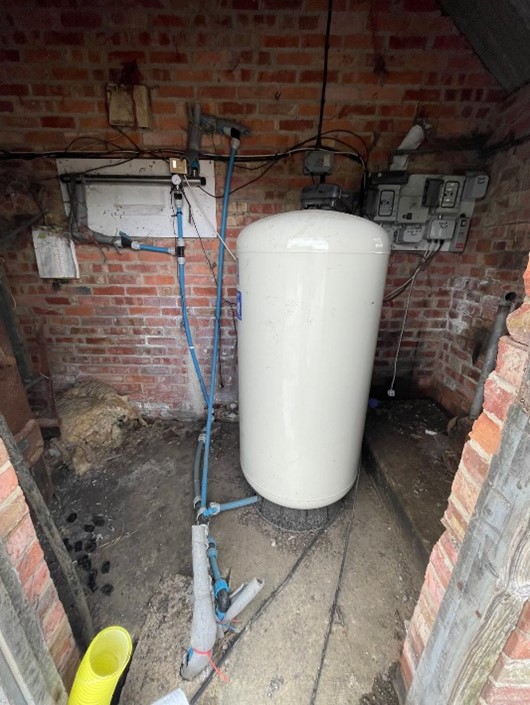
Figure 1.
This really does limit water pressure, particularly at peak times such as milking and when cows are drinking.
Replacing this system with a pressure set pump as in Figure 2. can be a relatively cost effective solution with each pump being dedicated to a particular line e.g., parlour, drinking troughs, cubicle sheds etc. The individual design can be thought through on a farm by farm basis. The principal is that the pressure set pump is set to a desired water pressure, which can be increased or decreased, thus ensuring there is sufficient distribution of water to individual points on the farm.

Figure 2.
In a lot of cases, farms are not short of water volume, they are short of water pressure. This system can vastly help with that.
If it is a volume issue many boreholes were drilled to a relatively shallow level e.g., 100-150ft and it is often worth seeing if these can be drilled deeper to access a greater volume of water. The first thing to do is monitor the volume you can potentially get from your borehole without going down the route of investment. This can be easily done by, for example, measuring how long it takes to fill an IBC with the water supply straight from the borehole.
These are simple, practical solutions that can be easily put in place on most farms and will generate a good saving when one considers the cost of mains water is well over £2/m³ or 1ppl + of milk produced on a dairy farm.
These are also relatively tax efficient investments and produce a good return on capital employed.
For an independent look at practical as well as financial problems, contact Max at maxsealy@fcgagric.com or your local FCG Office, for some commonsense solutions.
Categories
- Andover
- Arable & Crops
- Avon Meadow Sheep Group
- Beef
- Business Briefing
- Business Briefings
- Business Management
- Calne Dairy
- Carmarthen
- Chippenham
- Dairy & Forage
- Dairy Farming
- Discussion Groups
- Diverse Swards Group
- Diversification
- Environment
- Farm Assurance
- Gillingham Grazers
- Gloucester
- Grant Funding
- Guest article
- Health and Safety
- Human Resources
- Lincoln
- Midwest Grazers
- Milkwell Group
- News
- North Wiltshire Arable Group
- Office
- Organic
- Pigs
- Planning
- Regenerative farming
- Sheep
- Sherborne
- Soil
- South West
- Staff News
- Stafford
- Technical Update
- Uncategorized
- Wessex
- Wessex Springers
- WHDDG