Ellice Hahne (FCG Midwest)
Under Farming Rules for Water (FRfW), it is a requirement to test the soil for pH, P, K and Mg every 3-5 years. While many farmers will use the information regarding the nutrient levels, not everyone is aware of the importance of having the correct pH levels. If the pH is wrong, you will be wasting money on nutrients. Here are the reasons why.
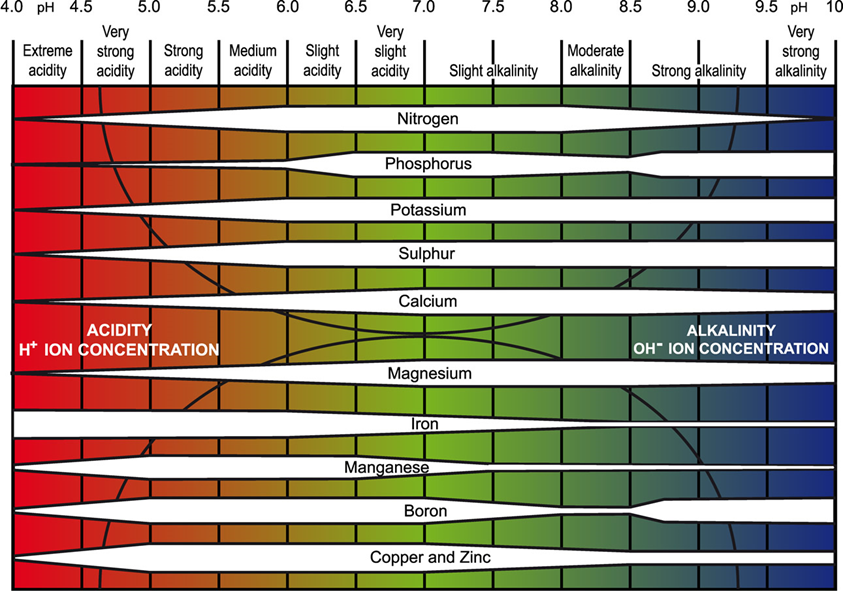
Nutrients are locked up or released into the soil depending on the pH of said soil. The image below illustrates it well, showing nutrient availability relative to soil pH. While many soils I see are not far off the ideal pH of 6-6.5 for grassland, some will slip into the 5.5-6 bracket, at which point the availability of P, K, S and Mg all start to decline. This means that even if your soil test results show an adequate amount of nutrients in the soil, these may not be available to the crop to grow, leading to lower yields.
Clover, which many farmers are starting to adopt into their grass swards as a way to reduce nitrogen input (and collect SFI payments), will not do its job properly if the pH is not maintained at 6-6.5, and may not fixate as much, if any, nitrogen. This defeats the point, and again, may keep yields lower than expected!
The best way to correct a low pH is to apply lime to the soil. Note that a pH that is too high can also bring problems with it, however this is more rare and more difficult to fix.
If you would like advice on pH and nutrient management, please contact Ellice at ellicehahne@fcgagric.com or your local FCG office.
Categories
- Andover
- Arable & Crops
- Avon Meadow Sheep Group
- Beef
- Business Briefing
- Business Briefings
- Business Management
- Calne Dairy
- Carmarthen
- Chippenham
- Dairy & Forage
- Dairy Farming
- Discussion Groups
- Diverse Swards Group
- Diversification
- Environment
- Farm Assurance
- Gillingham Grazers
- Gloucester
- Grant Funding
- Guest article
- Health and Safety
- Human Resources
- Lincoln
- Midwest Grazers
- Milkwell Group
- News
- North Wiltshire Arable Group
- Office
- Organic
- Pigs
- Planning
- Regenerative farming
- Sheep
- Sherborne
- Soil
- South West
- Staff News
- Stafford
- Technical Update
- Uncategorized
- Wessex
- Wessex Springers
- WHDDG