Morgan Gray (FCG Midwest)
A growing problem in the dairy and livestock industry is the release of gases such as ammonia from stored slurry. With environmental regulation beginning to be more stringently enforced, farmers are being pushed to find solutions that are both cost effective and compatible with their farming system. In my experience, this is an ever-growing problem for a particular subset of dairy farmers who are not prepared to move away from sand-based bedding systems amid fears that this will cause a spike in mastitis cases.
Limiting harmful gas release from slurry stores is most commonly done by covering the stores with fixed covers that aim to contain the gas. For the above group of producers covering a store tends to raise a key question; how can we dig out the settled sand if the store is covered by a fixed cover that can’t be removed without causing irreparable damage to the expensive cover?
The answer is… you can’t! However, there is a way that you can reduce the ammonia emissions from your slurry store by between 10 and 20%.

The diagram above shows a system where trees are used as shelter belts around a store to prevent wind from being able to flow over the slurry store, sweeping the harmful gas off the surface.
To maximise the capture of the gasses, trees should be planted in a way such as that shown in the diagram below.
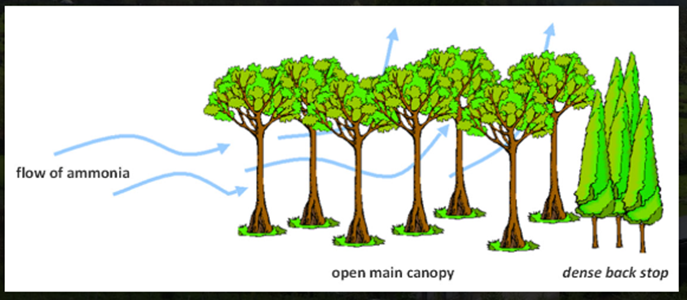
Ammonia will flow through the open, less densely planted trees before hitting the more densely planted trees which will force the ammonia up through the canopy, maximising the absorption of pollutants which happens in the leaves of the tree. This process helps to disperse the ammonia, reducing the impact on nearby habitats.
Studies have found that the most effective species at carrying out this process are Norway Spruce at a minimum of 2m tall.
For more information on cost effective slurry storage solutions, contact Morgan at morgangray@fcgagric.com or your local FCG Office.
Categories
- Andover
- Arable & Crops
- Avon Meadow Sheep Group
- Beef
- Business Briefing
- Business Briefings
- Business Management
- Calne Dairy
- Carmarthen
- Chippenham
- Dairy & Forage
- Dairy Farming
- Discussion Groups
- Diverse Swards Group
- Diversification
- Environment
- Farm Assurance
- Gillingham Grazers
- Gloucester
- Grant Funding
- Guest article
- Health and Safety
- Human Resources
- Lincoln
- Midwest Grazers
- Milkwell Group
- News
- North Wiltshire Arable Group
- Office
- Organic
- Pigs
- Planning
- Regenerative farming
- Sheep
- Sherborne
- Soil
- South West
- Staff News
- Stafford
- Technical Update
- Uncategorized
- Wessex
- Wessex Springers
- WHDDG