David Green (FCG Midwest)
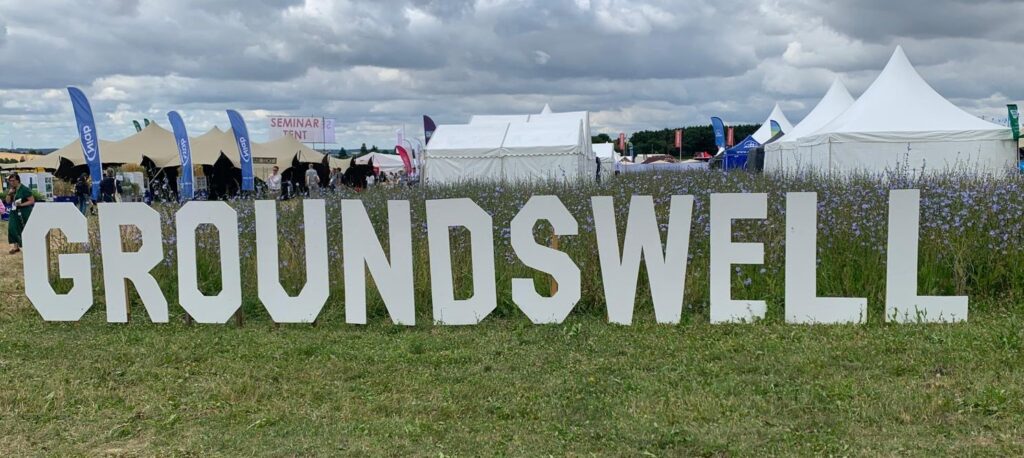
The most recent of my crusades to the informative Groundswell event led me to ponder several thoughts and questions in my mind. It is without doubt one of the best events I will attend this year, full of interesting people, speakers and stands showcasing all that stands behind regenerative principles. What perhaps was most conspicuous by their absence was the hard-faced commercial farmer. I could have had any number of discussions with researchers, academics, organisations of all descriptions or professional organisations including those within my own industry, but what was more difficult to find was the everyday practical farmer, and those I did see from Dorset expressed their surprised delight and not stopping every 10 metres to talk to someone they knew. Now admittedly Dorset is a fair distance from Groundswell but even so, the lack of farmers was noticeable across the 2 days.
This has led me to wonder if the theory and movement of Groundswell left the science and commerciality of grassroots farming behind, and if so why. Being a firm believer in most regenerative principles and the requirement for these to be adopted on farm for businesses to survive beyond the next 10 years of commodity production without government support; I therefore question the detachment away from the commerciality of farming and adopting some regenerative principles. Further thought has led me to believe there is a multitude of reasons that, until they are satisfied and overcome, will prevent a wider roll out of regenerative practices on farm. These reasons span everything from understanding principles through to capital required to implement change. Much of the required change, requires long term thinking, reductions in commodity production, investment in new ideas and a buy in from all parties within the supply chain from landlords right through to buyers of farm produced goods. Ultimately a lot comes down to the requirement to produce as much cash as possible and to generate profitability over the next 12-month period.
Unfortunately, due to the short natured thinking in being only able to satisfy high rents, loan repayments, and service high-cost enterprises, businesses are looking to maximise profit through continued production without being able to look longer term. There is a saying, “you can’t be green while you’re in the red”, and it refers to the ability of a business to change and adopt what could be termed sustainable practices while its financial viability is being put under pressure. When I look at my own business I often dream of a system utilising regenerative farming principles producing organic produce and then I think of how that would look financially for my own business and my own farm type. Whilst this is not something I could do in one hit, there are certain practices that I have the skill and mindset to adopt which do not require huge financial investment. As well as individual businesses having this mindset to change, we need the whole industry right from landlords, lenders, retailers, and processors to look harder at what they can do to help these changes be implemented on farms. My belief is that there is an underlying feeling of yes this is where we need to be, but the issue is how the changes are implemented widely without huge financial short-term suffering on farm.
Can the theory and the ideology of Groundswell be turned into science that can be proven on farm through commercialisation? Walking around the stands at the show and discussing the products, theories and services being sold by the exhibitors on show was fascinating, but with my “Dorset tenant farming” hat on, could I readily apply the theory on farm to prove the science to improve my commercial returns next year? I came away from a lot of stands with the thoughts of “yes, I would like to give that a go” or “yes I would like to adopt that principle” but I thought then of how and where, with my limited budget and land areas available, each requiring investment, time and space. I think all farmers know how they would like to farm, but dreams of practices and enterprises cannot always become reality within the constraints on farming in these times, with volatile support payments, high rents and loan repayments, demand for time and extreme weather events.
Something that was referenced in detail at Groundswell was a talk I attended on the movement of landlords such as the Duchy and Crown estate towards prescribing that new tenancies being granted are “regenerative”. What this means was supposed to be unveiled at the event, but the wait goes on to see the actual detail. The cynic in me would point the delay to an ongoing internal departmental tussle between a “commercial fixed term rent” and the view that the tenants should pay only what they can afford to in the year they start adopting regenerative practices on the holding as prescribed by the landlord through the legal terms of the tenancy agreement. After listening to the discussion, I think what would be far more suitable is a kind of share/partnership approach between landlord and tenant whilst methods are adopted, that way a combined long-term approach can be taken, alleviating some of the more short-term pressures such as profit and cash generation in year 1.
All in all, then, I will rush back again next year simply because I find it as an agriculturalist such an interesting event showcasing a movement that applies to all farmers of any nature. I will also need to continually apply the science behind the theory and see how this looks with my consultancy hat on, and what each change does to the financial bottom line. I have experience of implementation of change, and farmers should not think that all change requires huge investment or learning new science.
I’m sure that little by little the industry and the supply chain will adapt, and through incentivisation and greater educational farming practices, will become more regenerative and sustainable which will enable a thriving industry to be supported for many decades to come.
If you would like to discuss this further, please contact David Green at dgreen@fcgagric.com or your local FCG office.
Categories
- Andover
- Arable & Crops
- Avon Meadow Sheep Group
- Beef
- Business Briefing
- Business Briefings
- Business Management
- Calne Dairy
- Carmarthen
- Chippenham
- Dairy & Forage
- Dairy Farming
- Discussion Groups
- Diverse Swards Group
- Diversification
- Environment
- Farm Assurance
- Gillingham Grazers
- Gloucester
- Grant Funding
- Guest article
- Health and Safety
- Human Resources
- Lincoln
- Midwest Grazers
- Milkwell Group
- News
- North Wiltshire Arable Group
- Office
- Organic
- Pigs
- Planning
- Regenerative farming
- Sheep
- Sherborne
- Soil
- South West
- Staff News
- Stafford
- Technical Update
- Uncategorized
- Wessex
- Wessex Springers
- WHDDG