Phil Cooper (FCG Midwest)
This is part of a series of articles featuring cost focus and control on our clients’ farms. At times of low commodities prices, cost control is, of course, a really important area and should be seen as a cultural way to approach farming, rather than reacting to low prices by trying to slash costs.
Controlling the cost of fertiliser does not start with how much to buy or when to buy it but with the soil and crop being grown. No farm business should be making decisions on how much fertiliser to buy and use before:
- Soil testing to establish at a minimum soil pH, Phosphate and Potash levels and ideally soil organic matter, carbon levels, micro and macro nutrients. This will tell you what is in the soil already, what is available and therefore what additional nutrients are required.
- Correcting soil pH. At £25 to £30 per acre, lime applications are a far cheaper option than applying fertiliser to correct deficits. The diagram below shows how the wrong pH can lock up nutrients that would otherwise be available:
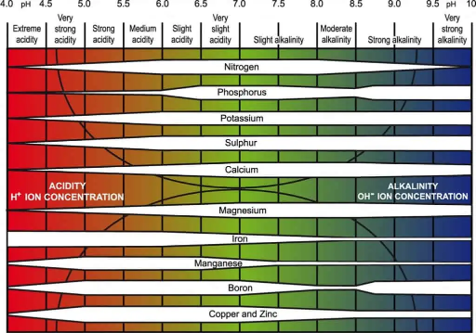
A quick glance at the diagram shows that once pH starts to drop below 6, the main nutrients the crop requires start to become less available. This is why there is an optimum pH for growing different crops!
Before considering the purchase of artificial fertiliser, establish what nutrients will be supplied by organic manures. This is influenced by:
- when the product is applied
- how it is applied, for example slurry injected supplies 5% more N than splash plate applications
- the dry matter of the product
- whether the slurry is separated
- the diet being fed to the stock producing the manure/slurry
- feedstock used in the bio-digestor
- bedding material used for the stock
- time between application and incorporation
Given there are so many variables, it is advisable not to use standard figures. Testing will give you true figures and allow a more accurate account to be taken of nutrients. This will help reduce costs by not underestimating the available nutrients. My colleague Allaster Dallas recently wrote an article on making the most of slurry: https://www.fcgagric.com/2026/06/15/you-are-invited-to-our-2026-milk-cost-of-production-report-launch-making-the-most-of-slurry-turning-variability-into-value/ and my colleague Gerard Finnan on the benefits of slurry testing: https://www.fcgagric.com/2026/07/03/simple-slurry-test-saves-time-money/
Your previous and current crops will further impact how much artificial fertiliser you need to apply, as some crops will take out more nutrients than others, and the market of your current crop will influence how much nutrients it requires to achieve its optimal quality.
Once you have this information a nutrient plan should be drawn up to ensure that, on a field by field basis, the right amount of nutrient is being applied to meet crop demands.
When you get to applying your fertiliser, you can then reduce your overall costs by ensuring you are making the best use of the product you are applying:
- Calibrate your machinery properly: an under-calibrated or poorly maintained spreader can waste 10-20% of applied fertiliser through uneven spread patterns, overlap, or incorrect settings. Regular calibration checks, GPS, and auto shut off on headlands are relatively low-cost fixes, (which can qualify for grant funding), that pay for themselves quickly by reducing waste and avoiding over application.
- Where soil type or fertility varies significantly across a field, variable rate application (VRA) allows fertiliser to be applied according to need rather than a flat rate across the whole area. While it requires an initial investment in mapping and compatible equipment, costs can be recovered within four years through reduce fertiliser usage and improvements in crop performance.
There are many other opportunities to reduce the cost of bought in fertiliser, those that are applicable will depend on the soil type, cropping and type of farming. Opportunities to consider include:
- Growing a cover crop will harvest nutrients in the soil, prevent nutrients leaching, increase organic matter levels, and if legumes are included fix nitrogen for the next crop to use.
- Dual cropping, e.g. growing barley and peas together, can reduce nitrogen requirements as the peas, a legume will fix nitrogen for the cereal crop.
- Nitrogen stabilisers, urease and nitrification inhibitors, and coated fertilisers can improve nutrient use efficiency, particularly in wetter conditions or on lighter soils prone to leaching. Adding these products can increase the cost per tonne, but where losses have historically been high, they can reduce the total nitrogen rate needed to hit the same yield target.
- Using foliar applications of nutrients rather than soil applied fertilisers can increase the usage efficiency and reduce overall requirements of fertiliser to achieve the same yields.
- Feeding the rooting zone with fungi at drilling will increase the soil biological activity which ultimately makes more of the existing nutrients in the soil available.
- Timing of purchase is important and using a buying group can help take the pressure from keeping track of what the market is doing.
Saving on the cost of bought in fertiliser is not simply a case of buying less, but it is about making the best use of what is already on the farm first and then topping up any shortages identified only where they are needed.
The key is to first understand your soils and what is already on the farm and then focus on making the existing nutrients more available rather than just applying more bought in fertiliser to bridge the gap.
The old saying “that’s what we’ve always done” no longer applies.
If you would like to discuss this further or receive advice on how to reduce your fertiliser bill, please contact Phil Cooper at pcooper@fcgagric.com or your local FCG office.
Categories
- Andover
- Arable & Crops
- Avon Meadow Sheep Group
- Beef
- Business Briefing
- Business Briefings
- Business Management
- Calne Dairy
- Carmarthen
- Chippenham
- Dairy & Forage
- Dairy Farming
- Discussion Groups
- Diverse Swards Group
- Diversification
- Environment
- Farm Assurance
- Gillingham Grazers
- Gloucester
- Grant Funding
- Guest article
- Health and Safety
- Human Resources
- Lincoln
- Midwest Grazers
- Milkwell Group
- News
- North Wiltshire Arable Group
- Office
- Organic
- Pigs
- Planning
- Regenerative farming
- Sheep
- Sherborne
- Soil
- South West
- Staff News
- Stafford
- Technical Update
- Uncategorized
- Wessex
- Wessex Springers
- WHDDG