Allaster Dallas (FCG Midwest)
I was lucky enough to attend this year’s BISAS Nutrition Conference. What struck me was the level of practical information that the speakers presented. My FCG colleague Max Sealy returned from this year’s Positive Farmers’ Conference with a similar message. And given the tough financial conditions facing the dairy sector, it is worth looking at the resources already on farm.
Huw McConochie’s presentation was particularly interesting. ‘Water the forgotten Nutrient’ is particularly apt in its use of forgotten. As with other biological and chemical functions that are going on unnoticed, in the background, so to speak. The role of water in agriculture is taken for granted.
Its use in nutrition is often overlooked and, in the minds of farmers, overtaken by cleaning equipment and yards. My colleagues have written articles on the need to collect and reuse water as well as provide systems with adequate pressure and flow.
The amount of water cattle need is directly linked to the amount of milk they produce, through the energy pathways involved in production and environmental constraints. In many dairies, the amount and timing of available water are constraints on potential production. A 10-20% reduction in water intake can lead to a similar reduction in milk yield.
On top of this, heat stress is adding to the requirements a cow needs to effectively maintain production levels. Mild heat stress, measured by the temperature-humidity index (THI), indicates that cows above an index of 68 would need between 5 and 10% more water.
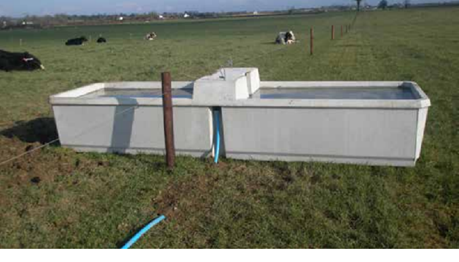
Water must be in the troughs, and the troughs must be clean; if they aren’t, the likelihood is that cows will be restricted and could potentially drink more water. This is also applicable to in-field troughs.
Placement and Availability.
Studies have shown that cows drink between 30% to 50% of their water intake around milking time. If they can’t access water easily at these times, the yield is likely to be affected.
Troughs often appear to be afterthoughts in building design. Placed in between passages, and you see cows building up around troughs, blocking others from moving between the feed bunker and lying areas. Look at whether troughs could be placed in loafing areas. I have yet to go on the farm and say, ‘I think you have too many water troughs.’
Pressure and Storage.
My colleagues have written about this in this link. https://www.fcgagric.com/2024/04/15/water-use-on-dairy-farms/
I would add to it by looking at peak flow. Work out what you need and when you need it. The results can range from 30 to 60 litres per minute.
Quality
In short, know what you are dealing with, as with any feed. The top-performing herds in terms of recorded milk per cow have the cleanest water. The top four problems included coliforms, turbidity, magnesium and iron content. All are linked to health issues within dairy herds.
Testing
When testing water, consider where you are taking the samples: from the source, storage tanks, or troughs. There may be an issue with one that may affect another.
If you would like any further information on calculating water requirements, please contact Allaster at allasterdallas@fcgagric.com or your local FCG Office.
Categories
- Andover
- Arable & Crops
- Avon Meadow Sheep Group
- Beef
- Business Briefing
- Business Briefings
- Business Management
- Calne Dairy
- Carmarthen
- Chippenham
- Dairy & Forage
- Dairy Farming
- Discussion Groups
- Diverse Swards Group
- Diversification
- Environment
- Farm Assurance
- Gillingham Grazers
- Gloucester
- Grant Funding
- Guest article
- Health and Safety
- Human Resources
- Lincoln
- Midwest Grazers
- Milkwell Group
- News
- North Wiltshire Arable Group
- Office
- Organic
- Pigs
- Planning
- Regenerative farming
- Sheep
- Sherborne
- Soil
- South West
- Staff News
- Stafford
- Technical Update
- Uncategorized
- Wessex
- Wessex Springers
- WHDDG